
- Posted on
- • SEO
How to Strategically Sell Advertising Space on Your Website
- Author
-
-

- User
- techub.digital editors
- Posts by this author
- Posts by this author
-

The Traffic Desert
When I launched my first website, I immediately went looking for ways to monetize it.
I read about AdSense, ad networks, selling space directly to brands. In theory it's simple, but then comes the cold shower: No traffic, no advertiser. No consistent content, no traffic.
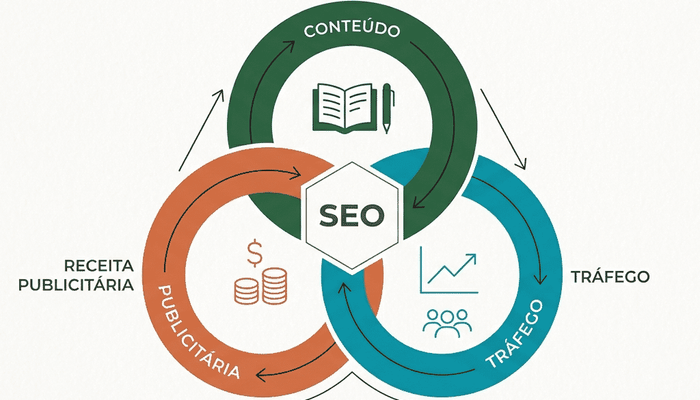
It's a cycle that stops a lot of people right at the start. You know you need content to attract visitors, visitors to attract advertisers, and advertisers to generate revenue to invest in more content. Where do you find the motivation?
The hack is to create long-tail content, explaining complex or everyday problems. That's how you actually start to rank.
In this article we'll cover selling ad space, what you need before trying to monetize, and how AI can solve the bottleneck that jams everything: consistent production of optimized content.
How It Works: Selling Advertising Space
Ad space is any area of your site you allocate to third-party ads — header, sidebar, mid-article, footer. You decide where and who gets to advertise.
There are basically two paths to monetizing these spaces:
Direct sales to advertisers — you approach brands, negotiate rates, and close contracts. Revenue is higher because there's no middleman. But it requires significant traffic (think hundreds of thousands of monthly visits) and considerable time spent prospecting and negotiating.
Sales through ad networks — you sign up for a platform like Adsterra, and it connects your inventory to existing advertiser partners. Compared to direct sales, the advantage is that you don't need to convince anyone — the system handles that. The network takes a percentage, but you start earning long before you hit millions of visits.
Pricing in networks works in three main ways:
- CPM (cost per thousand impressions): you earn for every 1,000 ad displays
- CPC (cost per click): you earn when someone clicks the ad
- CPA (cost per action): you earn when the user completes an action — signup, purchase, etc.
What Advertisers Look At Before Investing
The most important criteria I've identified so far:
Qualified traffic. It doesn't need to be huge, but it needs to be real and engaged. A high bounce rate — users leaving before the ad even loads — can impact performance projections.
Quality content. Thin or carelessly generated text content can even affect brand association. Content needs substance. If a Nike product appears in the middle of a poorly written article, people will associate Nike with something bad.
Clean, responsive design. An ugly site or one that breaks on mobile drives advertisers away before the conversation even starts. See how domain choice also impacts first impressions.
Transparency. Directly related to qualified traffic. When an advertiser asks for your numbers — pageviews, sessions, audience demographics — the numbers need to be clear and honest.
Before thinking about monetization, the work is building a solid foundation. And the biggest blocker for that is content production.
Content That Ranks Is the Asset That Unlocks Monetization
Traffic is the input for everything. Without it, you won't attract direct advertisers, you won't have the volume for ad networks to pay well, and you won't build a loyal audience that actually engages with your content.
The problem is that consistently producing SEO content is stressful and time-consuming. Keyword research, article structure, on-page optimization, regular publishing — these layers add up to hours per article.
That's when I discovered Soro AI.
What Is Soro and How Does It Work?
Soro is an SEO autopilot tool. You connect your site, it analyzes the domain, and starts suggesting and producing daily articles optimized to rank on Google — and also in AI results like ChatGPT.
The flow:
- You add your site URL
- Soro learns your domain's content and niche
- It generates topic suggestions with high-potential keywords
- You approve and it publishes — or schedules — articles directly
It's not a generic text generator. Before writing an article, Soro does keyword research, builds an optimized article structure, and integrates with your site for automatic publishing. User reports show jumps in CTR and impressions in Google Search Console within weeks of starting to use it.
How Does This Connect to Selling Advertising?
The logic goes:
- More ranking content → more consistent traffic
- More traffic → more valuable ad inventory
- More valuable inventory → better CPMs and growing revenue
- Growing revenue → budget to expand the site and invest in more authority
Soro solves exactly the bottleneck that prevents this cycle from spinning in the beginning: regular production of optimized content without depending on a writing team.
There's more: with better and more frequent articles, you can also place native ads naturally within the content — formats with the highest CPM and CPC, precisely because they integrate into the reading experience without interrupting it.
For those just starting out, before monetizing it's important to maintain stability on your site, as it directly impacts site performance and the advertiser's experience.

Ad Formats That Perform Best
For those using networks like Adsterra, three formats stand out in performance:
Popunder — opens a new tab when the user clicks anywhere on the site. High inventory fill rate.
Social Bar — a less intrusive format, visually similar to notifications. Good balance between user experience and revenue.
Native Banner — blends into the post content. This is the format that benefits most from well-written articles because the text context influences the relevance of the ads displayed.
When you produce content consistently, the natural result is a more valuable ad inventory. Contextual ads in long, well-placed articles earn more than banners on shallow pages with no engagement.
Two links I recommend for diving deeper into the technical specs of ad integration:
- Google AdSense official documentation — Placement best practices
- IAB Tech Lab — Ad format specifications
Content Is the Asset, Advertising Is the Consequence
Thank you for making it this far. I'll be honest — there's no shortcut here. But you can accelerate significantly with the right tools.
Soro solves the problem of continuous production. You define the niche, it handles the research and article generation. You focus on building authority, monetizing the spaces, and scaling as traffic grows.
For those starting out, my recommendation in order:
- Make sure your domain and infrastructure are properly configured — see our article on affordable .com.br domains in 2026
- Use Soro to publish content consistently from the first month
- Register your site with an ad network after your first publications go live
- Track CPM, CPC, and average position in Search Console to calibrate your formats
Try it free for 14 days
Soro researches keywords, writes optimized articles, and publishes daily to your site — while you focus on other things.
Discover Soro AI →This article references content originally published on the Adsterra blog about selling ad space, used as an informational source for citation purposes.